How to clean your room with ADHD

Take the decisions out of your head and put them somewhere you can see. With ADHD the room rarely gets cleaned because of low effort. It gets stuck because starting requires choosing a first step, and holding the rest of the sequence in working memory while you do it. Write the sequence down, or have something write it for you, and show yourself exactly one task at a time.
The problem is initiation, not willpower
Executive dysfunction shows up as a wall between knowing what to do and beginning it. You can see the mess, you know roughly what cleaning it involves, and you still cannot make the first movement happen. Being told to try harder does nothing, because effort was never the missing input.
What does help is removing the choice. When the first action is already decided, specific, and small enough to be almost silly, the wall gets low enough to step over.
One task on screen, everything else hidden
A twelve-item checklist is a distraction machine. You read item four, remember item nine, start item two, and lose the thread. The list itself is now part of the problem.
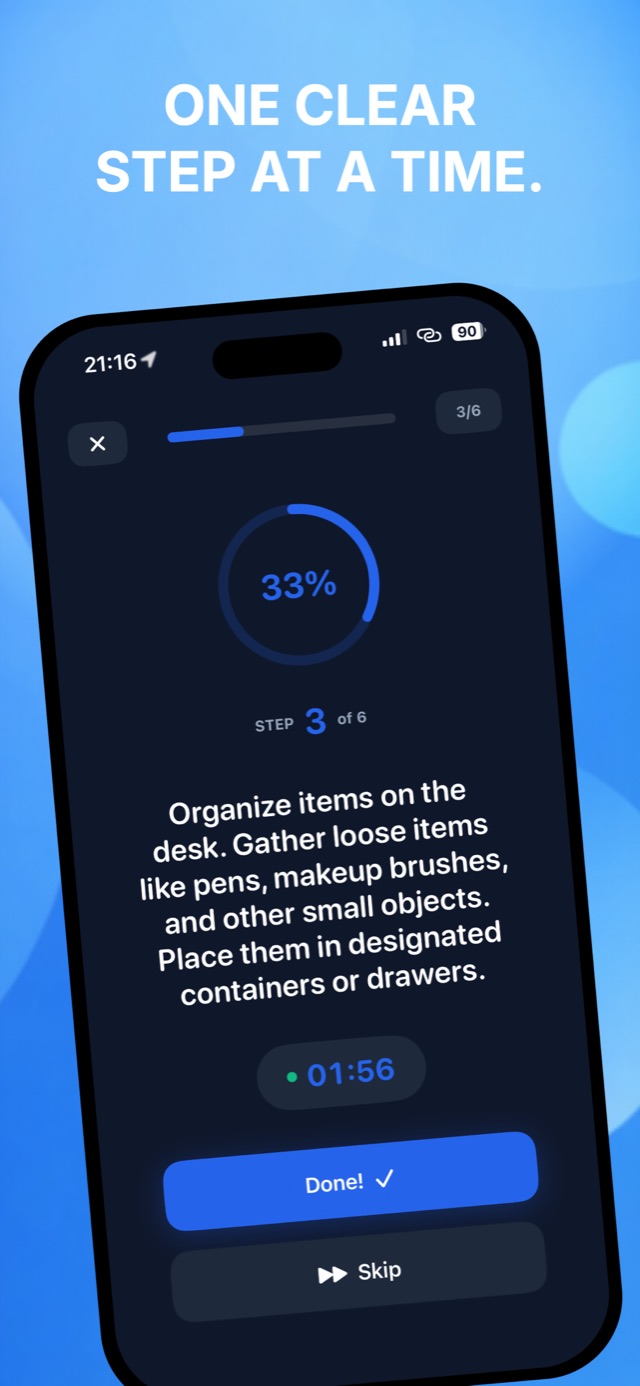
Show one task, do it, get the next one. This is why the app displays a single step with a progress ring instead of a scrollable list. You cannot jump ahead to the interesting task because you cannot see it yet.
Body doubling and timers do the same job
Both work by adding external structure. A friend on a video call, a timer counting down, a voice telling you the next step: each one takes the burden of self-direction off you for a while.
A countdown has a second effect worth having. It converts an open-ended chore into a finite game, and a finite game is much easier to enter. Two minutes on a nightstand is a bet you are willing to take.
Let yourself skip
Some tasks are aversive for reasons that make sense to you and to nobody else. The sink of old dishes, the drawer with the paperwork. Forcing those first usually ends the whole session.
Skip them, finish everything else, and come back when the room around them is calm. A skipped task is not a failed clean. Six out of seven is a good afternoon.
Keep the loop closed after the session
The bag by the door, the box of things that live elsewhere, the laundry in the machine: these are open loops, and open loops are where ADHD cleaning quietly unravels. Build one closing step into every session and treat it as part of the task, not a separate errand.
The other thing that helps is evidence. When the room is messy again in two weeks it is easy to believe you never clean. A streak counter and a weekly chart argue back with dates.

Questions about how to clean your room with adhd
Why is cleaning so much harder with ADHD?
Cleaning is a long chain of small decisions with no external deadline and no immediate reward, which is close to the worst possible shape of task for an ADHD brain. Structure supplied from outside, whether a person, a timer or an app, is what makes it tractable.
What is the best cleaning method for ADHD?
Any method that removes choice and shows one step at a time. Fixed-order category cleaning with a timer works well. The specific method matters less than never having to decide what comes next.